
For most of us, it’s an act so simple it’s unconscious. We turn a handle, and water appears—clean, safe, and seemingly infinite. It’s a quiet miracle we take for granted. But for nearly 800 million people worldwide, this simple act is an impossible luxury. For them, water is a burden carried for miles on the backs of women and children. It’s a source of debilitating disease, a barrier to education, and a constant threat to life.
Changing this reality is at the heart of humanitarian work. But what does it actually take to bring the miracle of clean water to a remote village? A water well is far more than just a hole in the ground; it's the culmination of a long and complex journey. It’s a masterpiece of geological science, meticulous engineering, deep community collaboration, and unwavering hope. At the Australian Relief Organisation, we believe in transparency and want to take you on that journey. From the initial spark of an idea to the first joyous splash of a pump, this is the story of how a water well comes to life.

Step 1: The Spark of Need - Identifying a Community
The journey doesn't begin with a drill rig, but with data, conversations, and a deep understanding of need. A water well must be placed where it can have the most profound and lasting impact. This selection process is deliberate, compassionate, and rooted in evidence.
? Data-Driven Humanity
The decision of where to build is never arbitrary. It’s a strategic process guided by a clear-eyed assessment of a community's struggle. ARO and its partners analyse a wide range of data points to identify regions of critical need:
Public Health Metrics: We look at local clinic records for high incidences of waterborne diseases like cholera, typhoid, and dysentery. These illnesses are a direct and devastating indicator of contaminated water sources.
Educational Statistics: School attendance records, particularly for young girls, often tell a story of water scarcity. When girls are tasked with fetching water—a chore that can take hours each day—their education is the first thing to be sacrificed.
Economic Indicators: We assess levels of poverty, agricultural output, and time lost to water collection. This data helps us understand the immense economic burden that a lack of accessible, clean water places on a community.
This data paints a picture of hardship, but it also illuminates a clear path for intervention. It points us to the exact places where a single well can begin to unravel complex, interwoven challenges.
? The Power of Local Partnerships
Data tells us where to go, but our local partners tell us how. ARO operates on a bedrock principle: sustainable change is only possible when it is led and owned by the community itself. We work hand-in-hand with trusted, on-the-ground NGOs and community leaders who possess an irreplaceable understanding of the local culture, social dynamics, and physical landscape.
These partners are our ambassadors and our guides. They conduct initial field visits, speak with village elders, and hold preliminary meetings to gauge the community's desire for a project and their willingness to participate in its long-term success. This foundational step of building trust ensures that we are not just providing a service, but are being welcomed as genuine partners in progress.
Step 2: The Blueprint - Surveying and Planning
With a community identified and a partnership formed, the technical and social planning begins. This is the crucial blueprinting phase where science meets strategy, ensuring that every dollar is spent effectively and the well will be a success for decades to come.
? Reading the Earth: Hydrogeological Surveys
Drilling for water without a scientific survey is like building a house without a foundation—it’s a costly gamble. To eliminate this risk, we bring in the experts. A professional hydrogeologist conducts a detailed survey of the proposed area. This process is like giving the earth an ultrasound, using sophisticated techniques like Vertical Electrical Sounding (VES).
The survey sends electrical currents into the ground to measure the resistance of the subterranean layers. Different materials—clay, sand, rock, and water—all have unique resistance signatures. By analysing this feedback, the geologist can:
Locate an Aquifer: Pinpoint the precise location of an underground, water-bearing rock layer.
Determine Depth: Accurately predict how deep the team will need to drill to reach a sustainable water source.
Estimate Yield: Assess the potential volume of water the aquifer holds to ensure it can meet the community's needs without running dry.
Preview Water Quality: Get an early indication of the water's potential purity, identifying any risks of salinity or natural contaminants.
This scientific rigour is non-negotiable. It is the single most important step in guaranteeing the long-term viability of the well.
?️ Designing the Well and Sourcing the A-Team
Based on the survey’s findings, engineers draft a specific design for the well. A deep borehole in a rocky region requires a different approach and different equipment than a shallower well in sandy soil. The design also dictates the type of pump—a sturdy, manual India Mark II handpump is perfect for many villages, while a solar-powered submersible pump might be better for a larger community or a school.
This is also where we activate the local business ecosystem. ARO is committed to a "local first" procurement policy. We hire local drilling companies, contract with local engineers, and purchase materials like cement, gravel, and pipes from local suppliers. This approach has a powerful multiplier effect:
It injects money directly into the local economy.
It creates skilled jobs and builds local capacity.
It ensures that spare parts and repair expertise are available nearby, which is vital for future maintenance.
???? Community Buy-In: The Most Important Contract
Before a single shovel of dirt is turned, the most important meeting of the entire project takes place. Our field officers and local partners sit down with the entire community. In this open forum, every detail of the project is discussed transparently.
We explain the findings of the survey, the timeline for construction, and, most importantly, the community’s role in the well’s future. The community is asked to make a commitment: to contribute what they can (perhaps unskilled labour, like digging a diversion channel for drilling fluid), and to elect a Water Management Committee. This committee, often comprising at least 50% women, will be the guardians of the well. This process of co-creation fosters a profound sense of ownership. It transforms the project from a piece of infrastructure being given to them into a shared asset they are building for themselves.
Step 3: Breaking Ground - The Art and Science of Drilling
This is the phase where the plan becomes a tangible reality. It's a period of noise, hard work, and palpable anticipation, as the community watches their future being drilled from the earth.
The Arrival of the Rig
The arrival of the drilling rig is a momentous occasion. It’s a large, loud, and powerful machine that represents a concrete promise of change. Children watch in awe, and adults gather with a sense of excitement. After years, and in some cases, generations of struggle, hope is finally taking shape right before their eyes.
The Drilling Process Explained
The drilling team, guided by the survey map, positions the rig over the precise spot. The process is a careful and skillful operation. A powerful drill bit, chosen for the specific geology of the area, begins to bore into the earth. As it descends, the team adds new lengths of drill pipe. A mixture of water and a special, non-toxic drilling mud is pumped down the pipe to cool the bit and carry the crushed rock and soil (the cuttings) back up to the surface.
The driller is like a pilot, feeling the vibrations and monitoring the cuttings to understand the layers they are passing through. They might hit soft clay, then a hard layer of granite that slows progress to a crawl. It requires patience, strength, and expertise to navigate these underground challenges.
? The Moment of Truth: Striking Water
After hours or even days of drilling, the moment everyone has been waiting for arrives. The driller feels a change in pressure and speed. The cuttings coming to the surface become saturated. And then, it happens. A surge of muddy water, pushed up by the pressure of the drill, gushes from the borehole.
A cheer erupts from the crowd. It's a primal, joyous celebration. This first sight of water is the emotional climax of the construction phase—a powerful, unifying experience for the drillers and the community alike. The promise has been fulfilled. Water is here.
Step 4: The Finishing Touches - Installation and Testing
Striking water is a milestone, but the job is far from over. The borehole must now be transformed into a safe, durable, and fully functional water well.
From Hole to Well: Pump Installation and the Concrete Apron
First, the borehole is cased. A long PVC pipe is lowered into the hole to prevent the walls from collapsing and to seal the aquifer off from any shallow, contaminated water. A special gravel pack is poured into the space between the casing and the borehole wall, acting as a natural filter.
The well is then "developed"—high-pressure air is used to flush out all the mud and sediment, leaving only clear water. Finally, the handpump mechanism is installed, and a thick concrete apron is constructed around the wellhead. This apron is sloped to channel spilled water away from the well, which is a critical feature to prevent surface contaminants from seeping back down and compromising the water source.
? Purity and Potability: Rigorous Water Quality Testing
Before the community can use the well, one final, crucial step must be taken. A sample of the water is collected in a sterile container and sent to a laboratory for professional quality testing. The lab runs a series of tests to check for:
Microbiological contaminants: Looking for harmful bacteria like E. coli and coliforms.
Chemical contaminants: Testing for nitrates, arsenic, fluoride, and heavy metals.
Physical properties: Checking the pH, turbidity (clarity), and mineral content.
Only when the lab results come back with a definitive "safe for human consumption" is the well ready for inauguration. This unwavering commitment to quality ensures that we are providing a source of health, not another source of illness. This is what a true charity clean water project demands.

Step 5: The Handover - Empowering for a Sustainable Future
A well that breaks down after a year is a failed project. The final and most important phase of the journey is ensuring the well will serve the community for generations. This is all about empowerment and education.
Training the Water Committee
The newly elected Water Management Committee undergoes comprehensive training from ARO’s local partners. They learn:
Basic Maintenance: How to perform routine checks, tighten bolts, and keep the well area clean.
Simple Repairs: They are given a toolkit and taught how to fix common problems, like replacing a seal or a washer.
Financial Management: The community agrees on a tiny, affordable fee per family to collect into a maintenance fund for future repairs.
Hygiene Promotion: The committee becomes a team of health ambassadors, teaching the community about the importance of handwashing and safe water storage.
? The Inauguration Ceremony
The official opening of the well is a huge celebration. The entire community gathers, often with singing and dancing. Local leaders give speeches, the water committee is officially introduced, and prayers of thanks are offered. An AROplaque is installed, a permanent reminder of the partnership and generosity that made it possible.
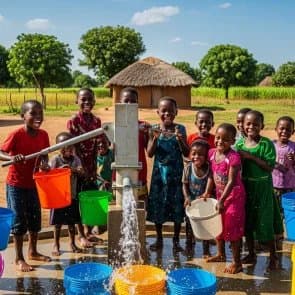
Then, a child or a village elder steps forward to take the very first pump. As the handle moves up and down, a stream of sparkling, clean, life-giving water flows out. That first drink is a taste of a new future—a future of health, of opportunity, and of hope.
Beyond the Pump: The Ever-Widening Ripple Effect
The journey doesn't end when the water starts flowing. In fact, that's where the true journey begins. The impact of a single water well radiates outwards, transforming every aspect of community life.
Health: Waterborne diseases plummet, and infant mortality rates fall.
Education: Girls are freed from the daily chore of fetching water and can finally enrol in school.
Economy: Women have more time to devote to income-generating activities, from farming to starting small businesses.
Agriculture: Access to water allows for small-scale irrigation, improving food security and creating surplus crops to sell at market.
A community stabilized by meeting its most basic needs is a community that is more resilient to all kinds of shocks. In regions recovering from conflict, establishing reliable infrastructure is a cornerstone of peace. This principle is universal, whether it's building wells in Africa or supporting long-term recovery efforts like those for healing Gaza. Providing a fundamental need like water is a powerful catalyst, much like how providing a cure for cataracts can restore an individual’s ability to participate fully in the life of their community.
The journey of a water well is long, technical, and deeply human. It is a testament to the idea that a better world is not just a dream, but something that can be meticulously planned, scientifically engineered, and built together, one community at a time. From a single point on a map to a gushing pump at the heart of a village, it is a journey that proves that a simple stream of clean water can truly change everything.
? You Have Questions? We Have Answers.
Q: How much does a water well typically cost, and how long does it last?
A: The cost of a well can vary significantly depending on the depth required and the local geology, ranging from a few thousand to tens of thousands of dollars. With proper community maintenance, a well-constructed one is designed to last for 20 years or more.
Q: Why is community participation so important for the success of a well?
A: Community participation creates a sense of ownership. When the community is involved from the planning stage and a local committee is trained for maintenance, the well is cared for as a shared and valuable asset, ensuring its sustainability long after the construction team has left.
Q: What happens if a major repair is needed that the local committee can't handle?
A: The maintenance fund collected by the community is the first line of defence. Additionally, by hiring local drilling companies for the initial construction, the expertise and heavy equipment needed for major repairs remain within the region and can be called upon when necessary.
Q: How do you choose between a hand pump and a solar-powered pump?
A: The choice depends on the community's size, the well's depth, and the water yield. Hand pumps are robust, simple to maintain, and ideal for smaller villages. Solar pumps can provide a much higher volume of water and are suitable for larger communities, schools, or clinics, but require more specialized maintenance.