You tap “Donate” on aro.org.au/give-qurban-2026. The screen confirms your $180. Your receipt arrives by email a few seconds later. And then… what?
For most donors, the donation is a leap of faith. You trust the charity. You trust the process. But you don’t see the steps in between. This piece walks you through them — from a click in Auburn (where ARO’s head office sits at 27 Queen St) to a family’s table in Cambodia, one of the 11 countries where ARO delivered Qurban in 2025.
If you’d rather start with the click, give your Qurban from $180 →.
Step 1 — The donation moment
You give your Qurban from one of ARO’s three 2026 tiers:
$180 for Africa, Asia & Pacific countries (including Cambodia, the focus of this story),
$230 for Where Most Needed,
$450 for Lebanon & Yemen.
The payment is processed through ARO’s secure online flow. A tax-deductible receipt under ABN 60 159 966 659 appears in your inbox almost instantly. Your name, the amount, the date — everything you’ll need for your 2025–26 tax return.
Step 2 — The aggregation phase
Between now and the days of Eid ul-Adha (expected around 27 May 2026), thousands of similar donations roll in from Aussie Muslims across NSW, VIC, QLD, WA, SA, ACT and NT — and from overseas. ARO’s finance team consolidates them under each region, allocating funds to:
Cambodia, Tanzania, and the other Pacific / Asian / African countries for the $180 tier,
Whichever country needs it most for the $230 tier,
Lebanon & Yemen specifically for the $450 tier.
Across 11 countries in 2025, ARO’s Qurban program funded the sacrifice and distribution that reached 24,000 families and 120,000+ people. 2026 is being built on that same infrastructure — same local teams, same accountability.
Step 3 — Local sourcing
In each country, ARO works with trusted local partners who know the livestock supply and the community in detail. Animals are sourced locally — not imported. This matters for three reasons:
It supports local economies, including the farmers and traders whose livelihoods depend on Qurban season.
The animals are appropriate for local conditions — breeds and care practices that suit the region.
Distribution can happen quickly once Qurban is performed, while the meat is fresh.
The animals are inspected against Islamic guidelines for age and health (see Qurbani Rules for the full criteria).
Step 4 — The sacrifice (Eid ul-Adha, the 10th–13th of Dhul Hijjah)
This is the heart of Qurban. During the days of Eid ul-Adha 2026, qualified individuals perform the halal Qurban on behalf of each donor. The sacrifice follows Islamic guidelines — the proper invocation, the prescribed method, the conditions of the animal.
For donors back in Australia, nothing is required at this step. You don’t need to be present. You don’t need to phone in your name. Your intention was set at the moment you donated; the sacrifice is performed on your behalf by ARO’s team during the days of sacrifice.
This is also the cut-off donors most need to know: your donation must reach ARO before the third day of Eid for the Qurban to be valid.
Step 5 — Distribution to families
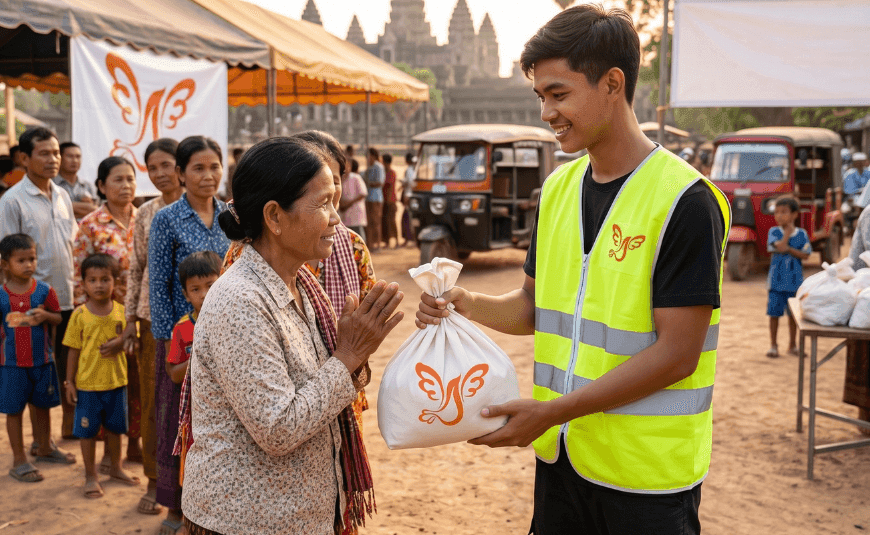
Once Qurban is performed, the meat is divided and packed for distribution. In Cambodia — to follow our example — packs are taken to communities ARO has been serving for years. Families receive fresh halal meat in dignified, respectful distributions.
In 2025, this looked like:
24,000 families reaching out with hands for a meat pack they hadn’t been able to afford that year,
120,000+ people fed across those households,
11 countries — from Cambodia and Tanzania to Lebanon and Yemen.
These aren’t just numbers. They are families who experienced the joy of Eid in a tangible way — protein on the plate, kids fed, an act of celebration rather than another day of going without.
Step 6 — Closing the loop
You won’t get a phone call from Cambodia. But what you will see, in the weeks after Eid, are the photographs and stories ARO publishes — visible across the ARO blog, the Hunger Relief category and ARO’s social channels (Facebook, Instagram, X, LinkedIn).
It’s also a documented chain you can audit: ARO is registered with the ACNC, endorsed by the ATO as a DGR, and registered as a Public Company by ASIC. The trust isn’t a vibe; it’s a paper trail.
What this means for you
When you give Qurban with ARO, what you’re paying for isn’t just the animal. You’re paying for:
The sourcing and inspection done by people you’ll never meet,
The qualified individuals performing the sacrifice on the right day, in the right way,
The cold-chain logistics that get fresh meat to the right families,
The accountability that makes you confident enough to do this again next year.
That’s what your $180 (or $230, or $450) buys.
Behind every Qurban is a deadline
Eid ul-Adha 2026 is expected around 27 May 2026, subject to moon sighting. Donations must be received before the third day of Eid. The earlier in the window your donation arrives, the more confidently each step in the journey can be executed — particularly in crisis-affected regions where coordination takes longer.
Start your Qurban’s journey today
You can be the click that starts it. From Auburn — or Sydney, Melbourne, Brisbane, Perth, Adelaide, Canberra, Darwin, or anywhere else — to a family table on the other side of the world.
Halal. Tax-deductible. Performed on your behalf in 11 countries. Australian Relief Organisation. ACNC Registered. DGR Endorsed. ABN: 60 159 966 659.
Want the full picture of Qurban 2026 in Australia? Start with our complete donor’s guide.